The following page provides information on the coverage of skills taught within mathematics and numeracy for the Spring Term. These are:
|
Place Value
|
• Round to the nearest 10, 100, 1000 and decimals to 3 places
• Order decimals to 3 decimal places
• Compare decimals to 3 decimal places using <>=
• X and divide by 10, 100 and 1000 including decimals.
• use place value and number facts to solve a range of problems inc. Measures
• To know the value of each digit in a 6 digit number
|
|
Statistics
|
Calculate and understand the mean average; construct and interpret distance/time line
graphs where intermediate points have meaning, including conversion line graphs;
understand pie charts are a way of representing data using percentages, interpret and
construct pie charts
• Pose questions to collect relevant data
• Draw and interpret a line graph
• Interpret information in a timetable
• Revise Carroll and Venn diagrams
• Use and interpret conversion graphs
• Explain what they have found out in their data
• Use digital skills where appropriate
• Complete a frequency table based on tally charts
• Find the mean, median and mode and range
Identify advantages and disadvantages of different questioning techniques when designing questionnaires
Use digital skills to create graphs
Group data to represent the class width
• Use appropriate vocabulary to describe the probability of an event (e.g., certain, impossible, even chance, likely and unlikely)
• Use contextual information to decide the likelihood of an event occurring
• Understand how these contextual factors may affect the outcome if they are changed
• Order events from certain to impossible
• Estimate, calculate and list the probability of an event occurring
• Carry out probability experiments
• List the outcomes of these experiments (e.g. spinners, coins, counters, number cards etc)
|
|
Addition and Subtraction
|
Mental
• Rehearse mental addition strategies for decimal and whole numbers.
• Use counting on to count in 3 place decimals to the next whole number.
• Add several numbers using mental methods.
Written:
• Add several numbers using column addition and choose the most appropriate
method to solve
• Add and subtract 6-digit numbers.
• Add and subtract decimal numbers to 2 decimal places
• Check answers using written column methods and the inverse operation where
appropriate
• Solve multistep problems
|
|
Position and Direction
|
• USe co-ordinates in the first (and four) quadrants
• Read and plot coordinates in all four quadrants, draw and translate simple polygons using coordinates and find missing coordinates for a vertex on a polygon; draw and reflect simple polygons in both the x-axis and y-axis using coordinates; find unknown angles around a point, on a line, in a triangle or vertically opposite and in polygons where diagonals intersect
• Accurate use of language
• A right angle is a ‘square’ angle
• Identify the totals of angle sin regular polygons
• Four right angles make a full turn, two right angles make a half turn
• Angle names and properties– right angle, acute angle, obtuse angle, reflex angle
• Know that angles are measured in °- revision
• Basic number and calculation skills (e.g. to find totals and differences to 90, 180,
270, 360)
• Draw and accurately measure angles with a protractor.
• Estimate the size of an angle
• Find the missing angle (link with algebra)
• Know what the angles of triangles, quadrilaterals, pentagons, hexagons and octagons add to and use these facts and mathematical reasoning to calculate missing angles
|
|
Multiplication and Division
|
Mental
• Revise fluency of times tables
• Find factor pairs
• Multiply and divide numbers by 10 and 100 up to 2 decimal places
Written
• Multiply 3 and 4 digit numbers using column method. Estimate answers.
• Divide 3 digit numbers by 1 digit using a written method including remainders.
• Use long multiplication to multiply 3 and 4 digit numbers by teen numbers. x
• Use appropriate multiplication and division strategies to solve problems.
• Knowledge of indices
• Square roots of numbers
• When dividing, write remainders of numbers as fractions or decimals to 2 decimal
places
|
Fractions, Decimals and
Percentages |
• multiply pairs of unit fractions and multiply unit fractions by non-unit fractions
• Use the four operations to calculate fractions
• Compare fractions and find equivalences.
• Simplify fractions
• Find fractional quantities of 3-digit numbers.
• understand that the value decreases as the denominator increases and vice versa
• Revise placing decimals on a number line and round to the nearest whole number.
• understand that noninteger quantities can be represented as decimals, fractions (including >1) and percentages
• Comparing and ordering decimals
• Know that percent means out of 100 and that fractions, decimals and percentages are all different representations of the same thing – part of a whole
• Explore equivalences between fractions, decimals and percentages
• Solve multistep real-life problems involving fractions, decimals and percentages
|
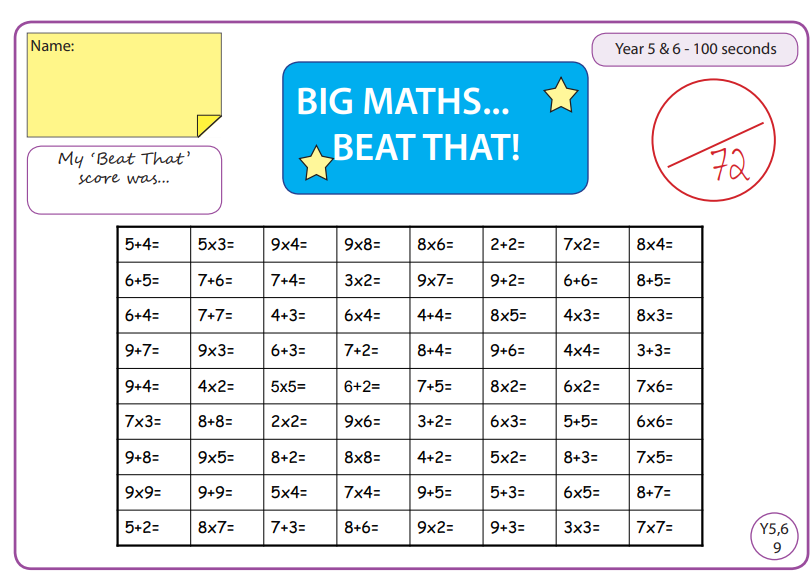
Pupils are challenged every week to improve their fluency in integral number skills such as multiplication and addition facts. Here is an example of the Year Six Big Maths Challenge. Pupils are encouraged to use the habit 'Get it Right!' to improve their scores and time. Here is an example below: